

How Mall Leasing Really Works (and Why It’s Not One-Size-Fits-All)
If you’re researching how to rent space in a mall, you’ve probably realized quickly that the answers aren’t simple.
Costs vary widely. Lease structures feel complex. Advice online often assumes every brand is either a national chain or a seasonal kiosk.
The truth is more nuanced.
Renting space in a mall looks very different depending on:
- Your stage of growth
- Your product category
- Your operational maturity
- Your long-term expansion strategy
- The trade area and metro market where the mall operates
Mall policies, leasing structures, and pricing can vary significantly depending on the market, local regulations, and the positioning of the specific asset.
This guide is designed to provide clarity.
Inside, you’ll learn:
- The different types of mall retail space available
- What typically drives cost and lease structure
- How to determine what format, cost structure, and level of commitment makes sense for your brand
- When mall retail is the right move — and when it isn’t
Most importantly, you’ll see that leasing isn’t just about square footage.
The environment, the trade area, the tenant ecosystem, and the operator behind the asset can materially influence your success.
Executive summary
Renting space in a mall is not a single decision — it’s a strategic sequence.
Retailers typically enter malls through one of several formats:
- Inline stores
- Temporary inline spaces
- Kiosks
- Pop-ups and short-term specialty leases
Cost is influenced by:
- Trade area quality and demographics
- Store size and placement within the mall
- Lease length and structure
- Demand and occupancy levels
- Tenant mix and traffic patterns
For small and emerging brands, malls can provide structured entry into brick-and-mortar with flexible formats.
For growing brands, malls offer scalable expansion in curated retail ecosystems.
For large retailers, mall leasing is part of broader portfolio optimization — renewals, relocations, reinvestment, and long-term asset alignment.
Mall retail often works best when:
- You have validated product-market fit
- Your margins support occupancy cost
- You understand physical retail operations
- You value foot traffic and co-tenancy
Brands may want to evaluate readiness carefully if:
- You are not operationally ready
- Your model depends entirely on ultra-low overhead
- You cannot support in-store staffing and inventory
Above all, leasing decisions are long-term brand decisions — not just real estate transactions.
Mall Space for Lease: What Your Options Really Are
When brands search “mall space for lease” or “small mall space for lease,” they often picture a traditional storefront.
But malls offer multiple entry points designed for different growth stages.
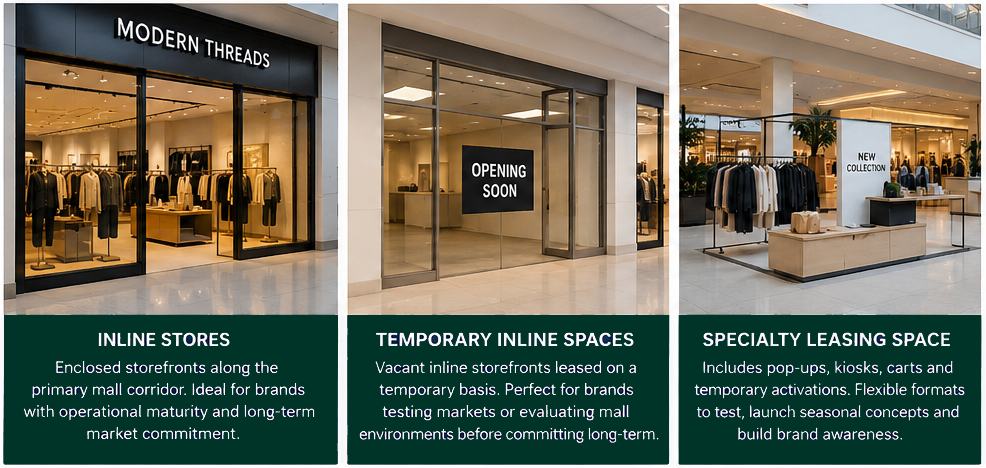
Inline Stores
Inline stores are enclosed retail spaces along the primary mall corridor. They are typically best suited for brands with:
- Established inventory depth
- Operational maturity
- Long-term market commitment
Inline stores offer:
- Strong visibility
- Adjacency to complementary brands
- Long-term brand presence
- Greater merchandising flexibility
For growing and mature retailers, inline space often becomes the anchor of a regional strategy.
Temporary Inline Spaces
Temporary inline spaces are vacant inline storefronts that are leased on a temporary basis while operators search for a long-term tenant.
This format allows brands to access the benefits of an enclosed storefront without committing to a long-term lease.
Temporary inline spaces are often used by:
- Digitally native brands testing physical retail
- Emerging brands validating demand in a new market
- Retailers evaluating a mall environment before committing to permanent inline space
Because the space already exists within the mall corridor, brands can experience full inline retail operations while maintaining shorter-term flexibility.
For many retailers, temporary inline space serves as a bridge between pop-ups or kiosks and a long-term inline lease.
Specialty Leasing Space
Specialty leasing space includes a range of short-term retail formats designed to give brands flexible access to mall environments.
These spaces may include:
- Pop-up stores
- Carts and kiosks
- Temporary inline stores
- Promotional activations
- Storage or operational support spaces tied to retail activations
These formats allow brands to:
- Test new markets
- Launch seasonal concepts
- Validate in-person demand
- Build brand awareness quickly
Many successful brands begin here before scaling.
A key misconception is that malls are only for large national chains. In reality, flexible specialty leasing allows emerging brands to enter strategically without long-term overcommitment.
Specialty leasing formats are often particularly effective for brands with smaller product assortments or limited inventory depth. Because the footprint is smaller and operational complexity is lower, these formats allow retailers to focus on high-margin or hero products while maintaining lower overhead.
The real question isn’t simply whether space is available.
It’s which format aligns with your current growth stage.
Average Rent for Commercial Space per Month (and What Drives Cost)
“Average rent for commercial space per month” is one of the most searched leasing questions.
The honest answer: rent varies — but not randomly.
What Mall Rent Typically Includes
Depending on structure, mall rent may include:
- Base rent (fixed monthly payment)
- Percentage rent (a portion of sales above a breakpoint)
- Common Area Maintenance (CAM) charges
- Marketing fund contributions
Understanding the structure matters more than focusing on a single monthly number.
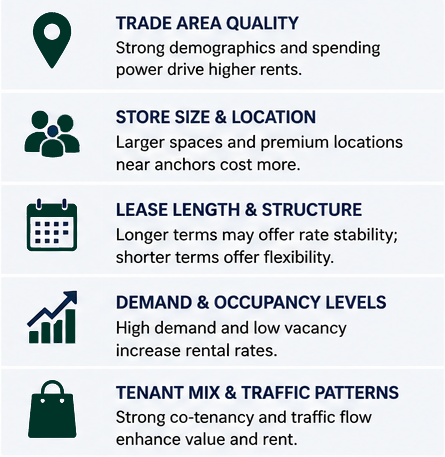
Primary Cost Drivers
- Trade Area Quality
High-income demographics, population density, and retail demand influence rent. - Traffic Quality (Not Just Volume)
Not all foot traffic converts equally. Proximity to anchors, experiential zones, or high-dwell areas increases revenue potential. - Store Size & Format
Inline stores carry different economics than kiosks or short-term specialty spaces. - Lease Length Longer terms often provide stability; shorter terms offer flexibility.
- Market Demand & Occupancy Levels
Strong occupancy and curated tenant ecosystems increase pricing power.
Rent as a Function of Revenue Potential
Experienced retailers don’t evaluate rent in isolation.
They assess:
- Sales per square foot
- Occupancy cost as a percentage of revenue
- Co-tenancy impact
- Long-term market durability
A lower rent in a weak trade area can be more expensive long-term than a higher rent in a strong ecosystem.
Retail performance is influenced by adjacency. The brands around you matter. The quality of the asset matters. The reinvestment strategy of the operator matters.
If you want accurate cost expectations, the best approach is direct conversation with a leasing representative who understands your specific footprint, margins, and category.
What Is a Normal Commercial Lease in a Mall?
There is no universal “normal” lease but there are common frameworks.
Core Components
- Base rent
- Percentage rent
- CAM charges
- Lease term length
- Renewal options
Terms Often Misunderstood
- Breakpoints in percentage rent
- Tenant improvement allowances
- Personal guarantees
- Co-tenancy clauses
Some aspects may be negotiable depending on:
- Concept strength
- Creditworthiness
- Market conditions
- Space type
For first-time tenants, clarity is critical. A transparent checklist and early conversations prevent costly misunderstandings.
Short-Term Commercial Leases and Pop-Ups: Testing Before You Scale
Short-term leases and pop-ups allow brands to test markets with reduced long-term commitment.
When Short-Term Makes Sense
- DTC brands entering physical retail
- Seasonal or limited-edition concepts
- Market validation before expansion
- Experiential activations
Pop-ups allow brands to:
- Gather real-world customer data
- Test merchandising strategies
- Refine staffing models
- Evaluate conversion rates
Risks and Limitations
Short-term formats may:
- Carry higher effective rent
- Offer limited long-term visibility
- Require fast operational setup
Flexibility is the benefit.
Operational readiness is the requirement.
When paired with experienced specialty leasing teams and supportive environments, short-term concepts can evolve into permanent inline stores.
Mall Kiosks: Costs, Setup, and Profit Potential
Kiosks are often viewed as “smaller stores.” Strategically, they are much more than that.
They can function as:
- Customer acquisition engines
- High-visibility marketing platforms
- Product testing environments
- Transitional steps toward inline retail
What Mall Kiosks Are (and Aren’t)
Kiosks are open-format retail spaces typically located in common areas and often in high-traffic zones like center court or major corridor intersections.
They work best for:
- High-margin products
- Demonstration-driven items
- Impulse-friendly merchandise
- Brands with simplified SKU strategy
They are not ideal for:
- Large inventory depth
- Complex store buildouts
- Brands requiring enclosed experiential storytelling
Location Within the Mall Matters
Not all kiosk placements are equal.
Strategic placement considers:
- Natural traffic flow
- Proximity to anchor stores
- Dwell-time areas (food halls, experiential zones)
- Complementary brand adjacency
Traffic volume matters.
Traffic intent matters more.
A kiosk placed near aligned retailers or experiential anchors often converts more effectively than one placed in purely high-volume but low-intent corridors.
Typical Cost Components
Kiosk investment includes:
- Rental fees
- Design and construction
- Fixtures and branding
- Staffing
- Inventory
While rental cost is lower than inline stores, design quality and staffing consistency strongly influence profitability.
Common First-Time Mistakes
- Underestimating staffing needs
- Choosing poor placement within the mall
- Overestimating impulse conversion
- Treating kiosks as temporary afterthoughts
A Pathway to Scaling
Many brands use kiosks as:
- Market validation
- Data collection
- Customer acquisition
- Proof-of-concept
Successful kiosk operators often transition into inline space once performance metrics justify expansion.
Kiosks are not the end goal, they are a strategic starting point.
How to Rent Space in a Mall Based on Your Stage of Growth
Leasing decisions should reflect where your brand is today — not where you hope it will be next year.
If You’re a Small or Emerging Brand
Focus: Minimize risk and learn brick-and-mortar fundamentals.
Start with:
- Pop-ups
- Kiosks
- Temporary inline space
Prioritize flexibility and market testing.
Avoid overcommitting to large footprints before validating in-person demand.
If You’re a Medium + Growing Brand
Focus: Intentional scaling.
Evaluate:
- Trade area demographics
- Tenant ecosystem alignment
- Long-term redevelopment plans
- Market saturation risk
Choose markets that strengthen your portfolio — not just expand it.
It is also important to evaluate the retail real estate operator behind the property. Strong operators manage a portfolio of assets, curate tenant ecosystems intentionally, and support retailers as they expand across multiple locations. For growing brands, the ability to scale with a partner across markets can be as important as the performance of a single store.
If You’re a Large + Mature Retailer
Focus: Portfolio optimization.
Mall leasing decisions become part of:
- Renewal strategy
- Relocation strategy
- Reinvestment allocation
- Performance benchmarking
Evaluate assets based on durability, reinvestment track record, and long-term traffic trends not just current occupancy.
Is Renting Space in a Mall Right for Your Business?
Mall retail is not right for every brand.
You may need to reconsider if:
- Your margins cannot support occupancy costs
- Your operational systems are underdeveloped
- You lack staffing infrastructure
- Your product does not benefit from physical discovery
Questions to Assess Readiness
- Do we understand our in-store conversion expectations?
- Can we sustain staffing costs?
- Is our inventory optimized for physical merchandising?
- Does our brand benefit from co-tenancy and foot traffic?
Strategic Advantages of Mall Retail
When aligned correctly, malls offer:
- Established foot traffic
- Curated tenant ecosystems
- Climate-controlled environments
- Integrated marketing support
- Built-in brand adjacency
Physical retail also functions as a marketing channel — strengthening omnichannel performance and increasing customer lifetime value.
Location is not just geographic. It’s strategic positioning.
Why the Right Mall Partner Matters More Than the Space Itself
Two malls can look similar in size and rent yet perform very differently.
The difference often lies in:
- Asset reinvestment
- Redevelopment strategy
- Tenant curation
- Local market expertise
- Operational support
A landlord provides space.
A retail partner provides ecosystem alignment.
Retail performance is rarely isolated. It is influenced by everything around you.
What to Do Next If You’re Considering Mall Retail
If You’re a First-Time or Emerging Retail Brand
- Clarify your entry format.
- Understand cost structure.
- Identify aligned markets.
- Speak with leasing professionals about readiness.
If You’re a Growing Brand Ready to Scale
- Evaluate trade areas.
- Compare lease structures.
- Pressure-test expansion plans.
- Align with operators that support repeatable rollout.
If You’re Managing a Large or Enterprise Retail Portfolio
- Assess asset durability.
- Evaluate reinvestment history.
- Analyze long-term trade area stability.
- Leverage local market expertise to improve performance.
Making the Right Mall Leasing Decision for Long-Term Growth
If You’re a First-Time or Emerging Retail Brand
- Clarify your entry format.
- Understand cost structure.
- Identify aligned markets.
- Speak with leasing professionals about readiness.
If You’re a Growing Brand Ready to Scale
- Evaluate trade areas.
- Compare lease structures.
- Pressure-test expansion plans.
- Align with operators that support repeatable rollout.
If You’re Managing a Large or Enterprise Retail Portfolio
- Assess asset durability.
- Evaluate reinvestment history.
- Analyze long-term trade area stability.
- Leverage local market expertise to improve performance.
Making the Right Mall Leasing Decision for Long-Term Growth
If you’re evaluating how to rent space in a mall, start with strategy not square footage.
The right format, lease structure, and market depend on:
- Your growth stage
- Your operational readiness
- Your margin profile
- Your long-term retail vision
Whether you begin with a kiosk, pop-up, small inline space, or full-scale store, success comes from aligning cost, ecosystem, and support with your brand’s trajectory.
Mall leasing is not simply about occupying space.
It is about choosing the right environment to help your business grow deliberately and sustainably over time.
Last Updated: August 11, 2026