

The word "booth" gets used loosely when people research mall retail. Depending on who you ask, it might refer to a cart in a common area corridor, a freestanding kiosk near center court, a pop-up space in a temporary inline location, or a table at a weekend makers market. Each of those formats carries a different cost structure, a different level of commitment, and a different set of operational requirements (see our article, How to Rent Space in a Mall: A Complete Guide for Retail Brands, for more information.)
Before you can get a useful answer to the cost question, you need to know which format you are actually asking about — and what drives pricing within that format.
The Formats Behind the Word "Booth"
Carts and RMUs (Retail Merchandising Units). These are the smallest and most flexible common-area layouts. An RMU is a pre-built, mobile retail structure owned by the mall and provided directly to the tenant as a turnkey merchandising solution. Because they sit right in the center of high-traffic corridors, require zero up-front construction, and feature short, flexible lease terms, they offer one of the lowest financial entry cost of any ongoing mall retail option.
Kiosks. These are larger, custom-designed common-area structures. While still positioned in the mall's open walkways, kiosks feature a fixed, dedicated footprint and greater merchandising capacity. Because they often integrate specialized utilities (like plumbing or heavy electrical) and require a more intensive construction process, they involve a higher investment and a longer commitment — typically requiring an 18+ month lease term.
Pop-up spaces and makers market tables. These formats are the most agile entry points for emerging brands and artisans. In a mall environment, many pop-up opportunities are open-air footprints or dedicated tables set up directly within common-area zones rather than fully enclosed spaces. These include short-term weekend events and seasonal makers markets that allow makers to set up in minutes to capture immediate event traffic.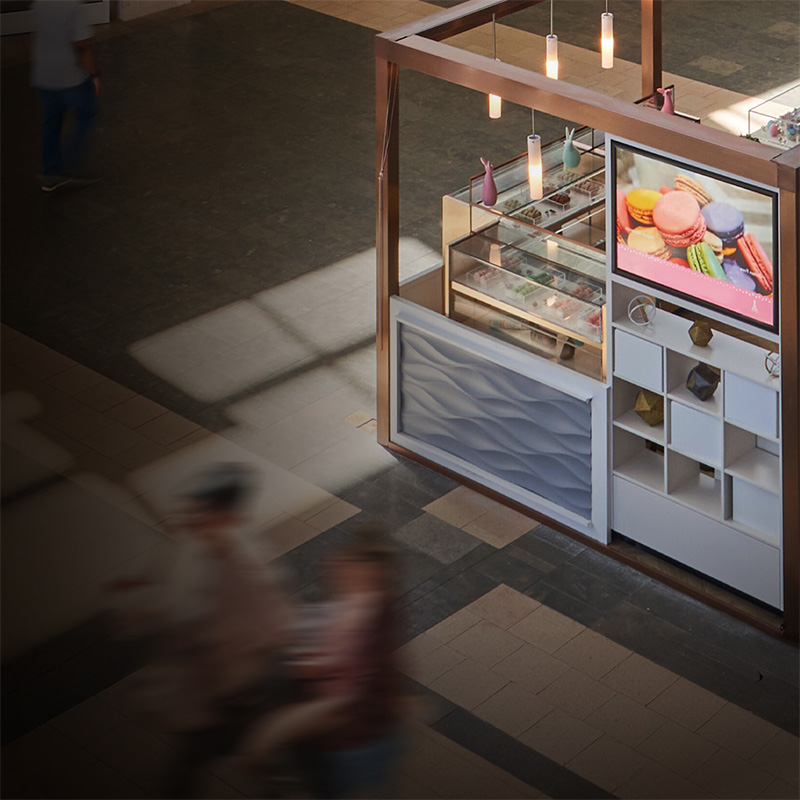
Temporary inline stores. These are traditional, fully enclosed storefronts leased on a short-term basis (typically spanning 1 to 13 months). They provide a complete, controlled brand environment and offer the closest experience to a permanent brick-and-mortar storefront without a multi-year commitment. Because they offer substantial square footage, temporary inline stores generally carry higher operational costs than common-area tables, carts, or kiosks.
For even more information about each of these store formats, check out our article on brick-and-mortar store options.
What Actually Drives the Cost
Across all of these specialty leasing formats, several variables consistently influence what you will pay.
Location within the mall. Not all positions are priced equally. A placement near a major anchor tenant, in a high-dwell zone such as a food court or entertainment area, or at center court will command higher rates than a secondary corridor position. The premium reflects genuine traffic and revenue potential — not arbitrary pricing.
Property tier and trade area. A property in a high-income, high-density metro market will carry different pricing than one in a smaller regional market. The strength of the trade area, the demographics of the surrounding community, and the overall positioning of the asset all factor into what specialty leasing rates look like at that property.
Footprint and format. Larger formats cost more than smaller ones. A custom-designed kiosk costs more to operate than a standard cart. A temporary inline space with a full storefront costs more than either. The relationship between footprint size and cost is relatively straightforward — what is less straightforward is whether the larger footprint generates the additional revenue to justify the additional cost.
Term length. Shorter commitments may carry a higher effective rate than longer ones. A two-week holiday pop-up may cost more per day or per week than a six-month specialty lease at the same location. Flexibility has a price, and that price is generally reflected in the rental rate.
Time of year. Specialty leasing rates are sensitive to seasonality. Peak periods — the holiday season in particular — carry premium pricing across all short-term formats. Brands evaluating a holiday activation should factor this into their financial planning and reach out to leasing teams well in advance of peak availability windows.
The Costs Beyond the Rental Fee
Rental fees are the most visible cost, but they are rarely the only one. Before finalizing any budget for a mall booth or specialty leasing format, account for the following.
Utilities. Depending on the format and the property, utilities may be billed separately from the base rental fee.
Insurance. Most specialty leasing agreements require tenants to carry general liability insurance. Confirm the required coverage levels before signing.
Design and build-out. For kiosks in particular, the physical structure is part of your brand presentation. Whether you modify an existing structure or build a custom design, this is a real cost that should be planned for before lease negotiations begin.
Staffing. A mall booth requires consistent, trained staffing to perform. Understaffing is one of the most common operational mistakes in short-term mall retail and one of the most direct causes of underperformance.
Inventory. The product you bring to a mall activation is capital at risk. Right-sizing your inventory for the format and the expected sales volume is part of the financial planning process, not an afterthought.
Marketing fund contributions. Some specialty leasing agreements include mandatory contributions to the mall's marketing fund. Confirm whether this applies to the format and property you are evaluating.
How to Get Accurate Cost Information
Published ranges for mall retail costs vary widely and often reflect market conditions, property tiers, or lease structures that may not apply to your situation. The most reliable way to understand what a booth or specialty leasing format will cost at a specific GGP property is to contact the specialty leasing team at that location directly.
When you reach out, be prepared to describe your concept, your preferred format, your target market, and your proposed timeline. The more specific you can be, the more useful the conversation will be. Specialty leasing teams can provide accurate, property-specific information that no published range can replicate.
Understanding the full cost picture before you commit — rental fees, additional obligations, build-out, and staffing — is what separates a financially viable activation from one that looked affordable until it wasn't.
Last Updated: August 11, 2026